Wednesday, November 28, 2012

The Oil Rush: Where's the Political Leadership for Sustainability?

By Jim Harding
Bakken Oil Rig
No Nukes
November 28, 2012

Our leaders aren’t really leading; they are following. They are following a big myth, even a delusion several centuries in the making that the economy can continue to expand without ecological blowback putting biodiversity, water quality, human wellbeing and our society at risk. The extreme weather events from global warming are the tip of the iceberg.

It’s taking a long time to sink in. Prime Minister Harper doesn’t get it and he may never. Premier Wall doesn’t act like he gets it either. Even past federal Environment Minister Jim Prentice, who was regularly briefed on climate change and spent some quality time with David Suzuki, still refuses to get it. Recently, speaking on CBC’s The National about the proposed Northern Gateway pipeline, he says “failure is not an option”. Growing carbon emissions didn’t seem to cross his mind; it’s full speed ahead with heavy oil production. As Vice President of CIBC, a major funder of and profiteer from the tar sands, Prentice says we must find a “second customer” and do this quickly.

Thursday, November 22, 2012

Jim Sinclair: Trying to find the man behind the myth

By Jim Harding
November 22, 2012

Sometimes we must search a little deeper for the words that can bring out vital yet still hidden realities. It can be risky, especially when you enter into the terrain of the heroic and mythic. Since Aboriginal Rights leader Jim Sinclair died I have been struggling to find deeper words and insights.

NATIVE RIGHTS WARRIOR

There’s no questioning Sinclair’s vital historical role in getting the Métis included in the Canadian Charter of Rights introduced by Prime Minister Trudeau. His shining moment was when he spoke, as a militant nationalist, at the failed First Ministers’ Conference on Aboriginal Rights in March 1987. You could tell that Prime Minister Mulroney was both stunned and impressed by the passionate and articulate case Sinclair made.

But because of my ongoing encounters with Sinclair I am left with some personal confusion about the man. My way of honouring his memory is to pursue this.

"Coming Soon!" No Expectations: A Memoir by James N. McCrorie

- NYC Books


Monday, November 19, 2012

Is the NDP becoming Liberal Lite?

November 19, 2012

A couple of polls showing the NDP losing support to the Liberals pose some pretty fundamental questions for the party and its small ‘l’ liberal leader Thomas Mulcair. Does the party follow the narrow political path of the two big business parties or does it reinvent itself as a movement party and tap into the deep dissatisfaction of Canadians about the state of politics and governance in this country?

The Harper Conservatives have mastered the techniques of the permanent election campaign – placing enormous pressure on the opposition parties to follow suit or find a way to counter them. Will the NDP try to replicate it (as the Liberals would like to) or will they, true to their radical roots, reinvent their approach and design a completely different “permanent campaign” model? The Conservatives have framed electioneering for the foreseeable future – if the NDP doesn’t respond with something new and imaginative it will lose.

Sunday, November 18, 2012

New NYC Booklet on Medicare

NYC

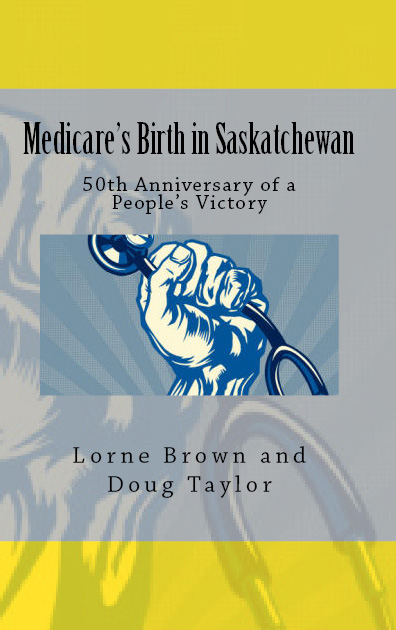
Medicare's Birth in Saskatchewan: 50th Anniversary of a People's Victory

The two articles re-published in this pamphlet were written to address the 50th anniversary of North America's first public healthcare system for all citizens initiated in Saskatchewan on July 1, 1962.

We were researching the prolific resources and books available on the subject in preparation for a forthcoming book on the fight for medicare in Saskatchewan and wanted to raise the profile of the anniversary as the actual anniversary approached.

This pamphlet is intended as a short and quick resource for labour and health care activists as we celebrate 50 years of medicare.


- Lorne Brown, Doug Taylor

Purchase HERE.

Which Road for the Saskatchewan NDP?

By John W. Warnock 
Act Up in Sask
16 November 2012


The campaign for the new leader of the Saskatchewan NDP takes off this Saturday with the first public debate among the four candidates. There are thirteen debates scheduled between November 17 and February 16, 2013. This will allow NDP members and others to see the differences between the candidates. The leadership convention is scheduled for the weekend of March 9, 2013 in Saskatoon.

As everyone knows, the provincial NDP is in dire straits at this time. Their support among voters has dropped from 275,000 in 1991 to only 127,000 in 2011. Their membership has dropped from 46,000 in 1991 to around 8,000 today. The turnout at elections has dropped from 75% of eligible voters in 1991 to only 50% in 2011. The provincial Liberal Party has all but disappeared, which means that the NDP will likely have to win close to 51% of the vote to once again form the government. They now face Brad Wall and the Saskatchewan Party whose government has had an approval rating of 70% in recent public opinion polls.

Wednesday, November 14, 2012

Interview with Lorne Brown, November 14, 2012

Rank and File Radio interviewed Lorne Brown, Professor Emeritus at the University of Regina and author of Trade Unions and Canadian Democracy: Democracy, Labour Laws, and Workers’ Rights, published by Next Year Country Books in 2012. 

In 2008, Lorne was retained by the Saskatchewan Federation of Labour as an expert witness in the legal challenge against The Public Services Essential Services Act in Saskatchewan. The book is a published version of Lorne’s written submission to the courts.
Click HERE to visit the site and hear the interview.

Purchase the book HERE.

Sunday, November 4, 2012

Thinking about Prairie Capitalism: Interview with Larry Pratt

Interview by Jeremy Mouat
Aurora


Aurora: Recently I was reading Prairie Capitalism, a book that you wrote in 1979 with John Richards, and I found myself wondering what you might think now. The book came out of a particular debate and a particular context, notably, the debate around the NDP Waffle and left nationalism. Yet the book also attempted something that hadn't been done before in Western Canadian historiography, it seemed to me. Before Prairie Capitalism, the literature had been almost exclusively narrative. Did you have this sense at the time, that you were writing a different account of Western history?

Larry Pratt: When John came to see me around 1975 – he was a Saskatchewan MLA about to lose his seat - we compared notes and we were struck by the similarities between the Blakeney NDP in Saskatchewan and the Lougheed Conservatives in Alberta. That was the first thing. The second was that we were both disenchanted nationalists. We came to feel that Lougheed couldn't be simply written off as an instrument of the working people, which is what a lot of people in the East were saying. I wrote a piece for Leo Panitch’s book, The Canadian State and in it I described a development strategy that was emerging in Alberta around petrochemicals.[1] It seemed to me that if a province was simply content to take the money and run, that that province wouldn't go through these tremendous difficulties trying to build a world class petrochemical industry. And there were a lot of other things - the Blakeney government in Saskatchewan was nationalizing potash. John and I thought that we would try to do something different. We would take the history of the two provinces right from their conception, through the populist period, to the first development period, then up to the present. John would write about Saskatchewan and I would write about Alberta, and then I would go over his work and he would go over mine. But John was a better economist than I was, and so he wrote the book’s last chapter, which I think is a really great chapter, on rent. The book probably arose out of the tremendous period of change that occurred after the price of oil went up so high in 1973-74. We had to account for the fact that these two provinces were behaving in very entrepreneurial sorts of ways. And some private factors were following.

Friday, November 2, 2012

A Bitter Anniversary: Remembering the Invasion of Grenada

By Kevin Edmonds
The Other Side of Paradise
October 22, 2012

Editor's note: I remember meeting with Vincent Noel, a trade unionist and prominent member of the New Jewel Movement. He was in Regina and met with solidarity activists here. He was humble, bright and full of enthusiasm for the new Grenada. He was among the first to be shot by Coard's thugs.- NYC


The second half of October is always a time of reflection amongst progressive forces in Caribbean, but especially so in Grenada. This is because October 19 marked the 29th anniversary of the death of Maurice Bishop, the Prime Minister of the People’s Revolutionary Government of Grenada. In addition, October 25, 1983 will mark the 29th anniversary of the invasion of Grenada—where the United States attacked the island’s population of 110,000 with 7,000 troops via land, sea, and air.

The right wing Heritage Foundation described the 1983 invasion as“The Reagan Administration's bold action to restore democracy and a free market economy to Grenada.” Ronald Reagan himself stated that it was “no invasion; it was a rescue mission.” Guyana’s Stabroek News was more precise, calling it “one of the most egregious examples of asymmetrical warfare in modern times, the United States of America, the world’s most powerful state, invaded Grenada, one of the world’s weakest mini-states.”

Given the context of the Cold War, the United States under Reagan had been busyundermining the revolutionary government in Nicaragua, aiding the right wing paramilitaries in El Salvador, and destabilizing the progressive government of Michael Manley in Jamaica. Reagan was also eager to score a military victory and restore the confidence that had been lost after the Vietnam War and the overthrowing of the Shah in Iran. This victory was to come at the expense of the Grenadian people, and the wider hopes of the Caribbean, in constructing a model of society based on social justice.

Grasslands in Peril: A public talk by Candace Savage

Candace Savage, best-selling author of "Prairie: A Natural History" and "A Geography of Blood: Unearthing Memory in a Prairie Landscape" is giving a public talk that highlights the heritage of the PFRA pastures.

These pastures, more than one million acres of public land, are some of the largest remnants of native prairie and sustainably grazed pasture that we have. They're valued for environmental, agricultural, recreational, and spiritual reasons. Now, the provincial government is putting them up for sal
e or lease.

Join Candace as she explains why these grasslands are important - and should matter - to everyone in Saskatchewan. The talk will be beautifully illustrated by a slide presentation of photographs from these vital grasslands.

Thursday, November 22, at 7:00 pm
Education Auditorium, University of Regina
Free parking in lots 13M and 14M


Candace's talk is a precursor to Friday's event: Public Pastures, Public Interest, a public forum and discussion on the future of Saskatchewan's public grasslands.

Sponsored by the University of Regina Departments of Biology and Geography, Campion College, RPIRG, and SM Solutions.

Saturday, October 27, 2012

Resistance to deportations growing

By Trish Elliott 
ActUpInSask
22 October 2012


A campaign to save two University of Regina students from deportation is gathering steam across Canada.

Today some 250 faculty and students attended a teach-in at the U of R, where organizers launched a Twitter campaign directed at citizen and immigration minister Jason Kenney and minister of safety Vic Toews.

By the end of the hour-long teach-in, the campaign’s Twitter account was already overloaded.

Victoria Sharon Ordu and Ihuoma Favour Peace Amadi are two Nigerian students who have taken sanctuary in a Regina church to avoid deportation. The pair worked at a WalMart for two weeks in the summer of 2011, violating a clause in their student visas that states international students may be employed on campus only.

Friday, October 19, 2012

Saskatchewan government contemplates sale of Information Services Corporation

Wall government considers privatizing despite the fact that ISC has posted nearly $100 million in net income most of which returned to the people of Saskatchewan.


NUPGE News
October 19, 2012

The Save Our Saskatchewan (SOS) Crowns Campaign is expressing concern for the future of Information Services Corporation (ISC) as the Sask Party government examines whether or not they will set the stage for privatization later this fall.

Recently the government announced that a ISC is being evaluated by RBC to determine whether or not they will introduce legislation in the fall to begin the process of privatizing the Crown Corporation.

Since 2007 ISC has posted nearly $100-million in net income, much of which is returned to the people of the province through dividends to Crown Investment Corporation (CIC), lowering the tax burden for all Saskatchewan residents.

The government cites difficulty in expanding business as the reasoning behind the suggested privatization. However, it would seem obvious that once privatized, an expanded ISC will not be returning any profits to taxpayers.

In 2008, former minister responsible for Crowns, Ken Cheveldayoff wrote in ISC’s Annual Report, that his priority was “to ensure that Saskatchewan’s Crown Corporations remain publicly owned...This is a promise our Government made to the people of Saskatchewan, and it is a promise we will keep.”

Concerns have already been surfacing around the government’s commitment to the privacy and security of Saskatchewan residents and businesses with their recent partnership announcement with Chinese-based Huawei.

SOS calls on the government to abandon their plan to determine the feasibility of privatizing ISC and re-evaluate their restrictive Sask First Policy that handcuffs the investment opportunities for all Crown Corporations in Saskatchewan.

Save Our Saskatchewan (SOS) Crowns Campaign is a broad based Coalition aimed at reaffirming to the people of Saskatchewan the importance of preserving and growing the Crowns, by ensuring all aspects of the Crowns remain in the hands of the public.

Monday, October 15, 2012

Stopping Nuclear Waste in its Tracks

Communities, Indigenous organizations pass resolutions against transportation and storage of nuclear waste in Saskatchewan

BY SANDRA CUFFE
October 2012

Growing numbers of communities in Saskatchewan are vowing to block nuclear waste from being transported through their territory. 

BEAUVAL, SK—Three places in northern Saskatchewan may be on the map in Canada's search for a high-level radioactive waste dump site, but the spent nuclear fuel bundles may be stopped in their tracks. Communities and Indigenous organizations along potential transport routes and beyond have been passing resolutions against nuclear waste.

The Northern Village of Pinehouse, English River First Nation and the town of Creighton are all currently in the Nuclear Waste Management Organization (NWMO) site selection process to find a "willing host community" for a deep geological repository to house the waste piling up at nuclear reactors in Quebec, New Brunswick and especially Ontario.

Canada’s Spy Groups Divulge Secret Intelligence to Energy Companies

Documents raise fears that info on environmentalists, Indigenous groups and more shared with industry at biannual, secret-level, briefings.

BY TIM GROVES
October 10, 2012

Since 2005, the Canadian government has been organizing secret-level meetings between federal law enforcement and intelligence agencies and energy corporations to share intelligence on environmentalists' activities. 

The Canadian government has been orchestrating briefings that provide energy companies with classified intelligence from the Canadian Security Intelligence Service, the RCMP and other agencies, raising concerns that federal officials are spying on environmentalists and First Nations in order to provide information to the businesses they criticize.

The secret-level briefings have taken place twice a year since 2005, and are detailed in documents obtained under the Access to Information Act, and in publicly-available government files.

The draft agenda for one of the briefings, acquired by The Dominion, shows that the RCMP and CSIS assisted the department of Natural Resources in organizing a daylong event on November 25, 2010, at CSIS headquarters in Ottawa, and a networking reception the previous night at the Chateau Laurier.