Tuesday, January 4, 2011

What's Happening On The Korean Peninsula?

Martin Hart-Landsberg
The B u l l e t
Socialist Project • E-Bulletin No. 448

What's happening on the Korean peninsula? If you read the press or listen to the talking heads, your best guess would be that an insane North Korean regime is willing to risk war to manage its own internal political tensions. This conclusion would be hard to avoid because the media rarely provide any historical context or alternative explanations for North Korean actions. For example, much has been said about the March 2010 (alleged) North Korean torpedo attack on the Cheonan (a South Korean naval vessel) near Baengnyeong Island, and the November 2010 North Korean artillery attack on Yeonpyeong Island (which houses a South Korean military base). The conventional wisdom is that both attacks were motivated by North Korean elite efforts to smooth the leadership transition underway in their country. The take away: North Korea is an out-of-control country, definitely not to be trusted or engaged in negotiations.

But is that an adequate explanation for these events? Before examining the facts surrounding them, let's introduce a bit of history. Take a look at the map below, which includes both Baengnyeong and Yeonpyeong Islands.

"No Human Being is Illegal"

Poster by Mark Vallen


To oppose the rising tide of discrimination aimed at the undocumented in the U.S., from Arizona's racist SB1070 anti-immigrant law, to efforts by members of the U.S. Congress to overturn the 14th Amendment of the U.S. Constitution (which guarantees citizenship to children born on U.S. soil), Vallen republished his famous poster in August of 2010.

"No Human Being is Illegal" was first published as a bilingual street poster in 1988 in conjunction with a campaign conducted by the Los Angeles based Central American Resource Center (CARECEN), to secure the rights of undocumented Central American war refugees in the U.S. The 5,000 posters distributed popularized the slogan of "No Human Being is Illegal," a catchphrase that has since entered the lexicon of today's defenders of immigrant's rights.

Monday, January 3, 2011

Entryism in Theory, in Practice, and in Crisis: The Trotskyist Experience in New Brunswick, 1969-1973

By Patrick Webber
Left History 2009

Since the emergence of a distinct Trotskyist faction within the Communist movement by the mid-1930s, the policy of entryism has been a favourite tactic among Trotskyists, particularly in the West. Entryism would be a major factor in the creation of the New Brunswick Waffle in 1970, the provincial wing of the Waffle
movement that had emerged in the New Democratic Party (NDP) the previous year.

Conflicting interpretations over the implementation of entryist theory, however, would also help split and destroy the NB Waffle by the end of 1971 and inflict lethal damage on the nascent Trotskyist movement in New Brunswick. The ultimate impact of the crisis in entryism provoked by the Trotskyist experience in
New Brunswick in 1970-71 was to raise major doubts about the theory and practice of entryism among Canadian Trotskyists, culminating in the fracturing of the League for Socialist Action (LSA), Canada’s pre-eminent Trotskyist organization.

The events that surrounded the NB Waffle therefore proved to be a turning point in the history of Trotskyist strategy in Canada.

Read more HERE (pdf).

Burns Night With Tommy Douglas

Next Year Country

Tommy Douglas reads at a Burns Night. When can you remember an NDP leader talking about class or class structure?


Harper's Pipeline Nightmare

The PM backs the Enbridge plan to pipe tar sands crude to the BC coast. But the politics are ugly.

By Murray Dobbin
TheTyee.ca

What kind of year in politics is 2011 going to be? Very likely another year (or at least ten months) of gridlock at the federal level, with no sign of any so-called game changer on the horizon.

A spring election is looking less likely as the Conservatives try to make a deal with the NDP -- swapping its support for the budget for increased support for seniors and hopefully a halt to scheduled corporate tax cuts. Harper seems resigned to remaining a minority government and doesn't want an election. Canadians are no more willing to give him a majority today than they were last year or in the last election. As soon as a Harper majority appears possible, a whole whack of voters change their minds and the Conservatives go back to their maximum maintainable level of 36-38 per cent.

So if there is so little meaningful action on the parliamentary political front, we should look to extra-parliamentary politics for action. And here the movement seems to defy the polls. Because while environmental issues are still taking a back seat to economic ones, it is on the environmental front that stuff is actually happening. While the media seem to focus on the lack of action on climate change, other enviro issues are witnessing intense activity and campaigning by dozens of groups.

Dilma Rousseff: In Lula's Shadow

Benjamin Dangl
The Nation

When the confetti was still falling after her victory at the polls on October 31, Dilma Rousseff, Brazil's first female president-elect, said, "I want to state my first commitment after the elections: to honor Brazil's women so that today's unprecedented result becomes a normal event and may be repeated and enlarged in companies, civil institutions and representative entities of our entire society."

In a country where women have typically played a limited role in politics, the election of a woman to Brazil's highest office signals a major break from the past. But Rousseff's term will likely be marked by continuity with her predecessor, Luiz InĂ¡cio Lula da Silva. Lula, a member of the Workers' Party (PT), is leaving office with 87 percent support in the polls. An economist, PT bureaucrat, chief of staff under Lula and former guerrilla in the anti-dictatorship movements of the 1960s and '70s, Rousseff was handpicked by Lula to follow his lead as president. When she is sworn in on January 1, she will inherit Lula's popular legacy and will be further empowered by the fact that her party and allied parties won a majority of seats in the Senate and Congress. Not even Lula counted on this much support.

Sunday, January 2, 2011

Announcing NYC's New Socialist Retro Website

NYC has started a new website devoted to Saskatchewan socialist retro documents.


Beginning with issues of the Saskatchewan Waffle's Next Year Country, other documents from Saskatchewan's rich socialist legacy have been added. At this time only a few documents have been loaded up as pdfs but check back monthly for updates.

Follow this link to NYC's new flash-based website!

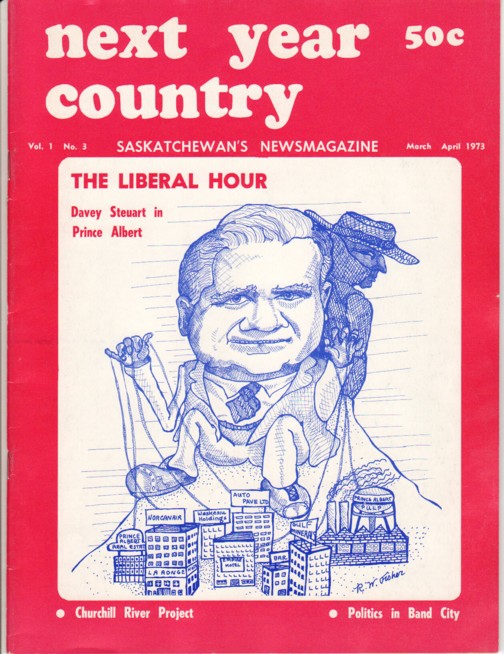
NYC Retro 1973

NYC March/April 1973:  A Publication of the Saskatchewan Waffle

In this issue:
Churchill River Project by Doug Whitfield
Kim Thorson by John Conway
Politics in Band City by Martha Tracey
The True North


Major James "M. J." Coldwell 1888-1974

Douglas-Coldwell Foundation

The Honourable Major James William Coldwell, PC , CC (December 2, 1888–August 25, 1974), usually known as M.J., was a Canadian socialist politician, and leader of the Co-operative Commonwealth Federation party from 1942 to 1960. Major was his first name, not a military title.

Coldwell was born in England. He moved to Canada in 1910 and became a school administrator in Regina, Saskatchewan. He became known nationally as a leader of teacher's associations from 1924 until 1934. He was elected to the city council in Regina and developed links with labour and farmers organizations.

Canadian Labour in Crisis: Reinventing the Workers’ Movement

Fernwood Books

Does Canada have a working-class movement? Though many of us think of ourselves as middle class, most of us are, in fact, working class: we work for a wage. And though many of us are members of unions — the most significant organizations of the working-class movement in Canada — most people do not understand themselves to be part of this movement. Canadian Labour in Crisis asks why this is so.

Through an analysis of the contemporary Canadian working-class movement and its historical development, David Camfield offers an explanation for its current state and argues that reform within the movement is not enough. From the structure of organizations to their activities and even the guiding ideology, Camfield contends that the movement needs a radical reinvention — and offers us a new way forward in reaching this goal.

Contents
Introduction • Part One: The Working-Class Movement Today • Unions and the Workplace • Union Activity Beyond the Contract • Inside the Unions: Organizational Life • Other Working-Class Movement Organizations • Assessing the Contemporary Working-Class Movement • The Roots of Today’s Problems • Part Two: Looking Forward • Why Reinvent the Movement? • How to Reinvent the Movement? • Readings and Resources • Concepts • References • Index

About the Author:
David Camfield is an associate professor in labour studies at the University of Manitoba.

Avalibale in April from Fernwood Books
Book excerpt HERE.

Saturday, January 1, 2011

Saskatchewan Now Targeted For Nuclear Dump

By Jim Harding
RTown News

The industry-based Nuclear Waste Management Organization (NWMO) has confirmed that two of the four Canadian communities that it is talking to about becoming a nuclear dump are in northern Saskatchewan; at Pinehouse and English River. The other two are in northwestern Ontario, much closer to the nuclear power plants along the Great lakes that produce almost all of the nuclear waste in Canada.

Speaking for the English River band, Councilor Bernie Eaglechild said that “nothing has been decided and talks are still at an early stage”, emphasizing that “the band can still back out at any time.” Pinehouse mayor, Mike Natomagan, who also heads the Kineepik MĂ©tis Local, had a similar message; that this “learn more opportunity does not commit the village or MĂ©tis local to any further steps.” This doesn’t mean “Pinehouse has said ‘yes’ to the project”.

Gladys Strum: Farm Woman, Teacher and CCF MP/MLA

By Georgina M. Taylor

Gladys Strum, January 1961.
Ralph Vawter (Saskatchewan Archives Board)
Gladys Strum, like many women in Canadian history, was a juggler. She spent her adult life juggling the various roles she played as a farm woman, teacher and politician. Her strong political convictions grew out ofher experiences as a farm woman on the prairies in the 193Os. As the only woman in the House of Commons from 1945 to 1949 she was like the pork in a can of pork and beans, "vastly outnumbered."

Women politicians had to develop very tough hides in order to endure the often vicious slings and arrows that the world threw at them. This Strum learned during a political career in which she became the first woman in Canada to be elected the president of a political party, the fifth woman MP, and fifth woman MLA in Saskatchewan. While she was a politician she was also working as a farm woman, wife and mother and often, in addition, she was going to university and running a boarding house, running a motel, or teaching school.

Read more HERE.

The Founding of the Co-operatives

A record of the founding meeting of the Fogo Island Ship Building and Producer Co-operative(1967).


The Fogo Island Process evolved from a series of events that took place on Fogo Island in 1967. Two years before, Donald Snowden, the then Director of the Extension Department at Memorial University, proposed the idea of producing a series of films to show the people of Newfoundland and Labrador that poverty did not mean economic deprivation, it could also be the result of isolation and the inability to access information and communication through media as well as a lack of communication.

Snowden teamed up with Colin Low, a filmmaker with The National Film Board of Canada, and considered five areas in Newfoundland for potential filming before deciding Fogo Island was the ideal candidate to initiate what is now known as the Fogo Island Process.

In 1967, less than five thousand people lived on Fogo Island, living in ten separate communities. Fogo Island represented the type of isolation and lack of information or organization that Snowden wanted to show as alternate indicators of poverty in the province.

Fogo Island at that time was going through an economic slump. The Island depended on the fishing industry for three hundred years, but the inshore fishery was failing, and sixty percent of families were forced depend on welfare. These circumstances brought about the possibility of resettlement.

Snowden believed that the people of Fogo Island could form a co-operative in an effort to preserve their way of life. Colin Low was introduced to Fred Earl, a Memorial University Extension Worker, and attended a meeting of the newly formed Improvement Committee, a group of members formed from the ten communities across the Island. They introduced the concept of filming on the Island, and identified a number of Island wide issues: the inability to organize, the need for communication, the resentment felt towards the idea of resettlement, and the anger toward the fact that the government seemed to be making decisions about Fogo Island’s future with no community consultation process.

By using the technique of filming, communities as well as government officials were able to see how the people of Fogo Island felt about the issues they faced concerning the fishery. It was clearly identified that the government was making decisions for Fogo Island without community consultation. This became an important part of the Fogo Island Process, as individual communities were united in their concern for their livelihood and for the future of Fogo Island.

As a result of the films, fishermen were given the opportunity to voice their concerns to cabinet ministers and other government officials. Soon, alternatives were made to the original proposal of resettlement, which was initially pushed by Premier Joseph Smallwood.

Today, the Fogo Island Co-operative is prospering. The Fogo Island Process is only one factor in a success story for which most credit must be given to the people. As film producer Colin Low said, the films "intensified" a process already begun. The Fogo Island Process became an internationally acclaimed prototype of using media to promote dialogue and social change and was the model used by various communities in similar economic situations around the world.

First Woman President of Brazil Vows to Fight Single-mindedly for the Eradication of Poverty

Workers Party of Brazil


After taking office in Congress, Rousseff made the first speech as President of the Republic. In a speech marked by emotion, it reaffirmed its commitment to work single-mindedly to eradicate poverty and to consolidate the transformation process through which runs the country after eight years in office of President Lula.

Dilma also noted the strength of the Brazilian woman and said he had been elected to run the country is a tribute to all Brazilian women. "I come not to praise my biography, but to glorify every Brazilian woman.  My commitment is to honor women, protect the weak and govern for all, " she added.

Dilma also paid tribute to former President Luiz Inacio Lula da Silva and assured that he will continue his work.  "I come before everything, to continue the larger process of affirmation that the country has experienced in recent times to consolidate the transforming work of President Luiz Inacio Lula da Silva, who had the most vigorous political experience of my life and the privilege to serve the country in recent years, " she said.

"A president who changed the way of ruling and taught the Brazilians to trust in the country. Under his leadership, the Brazilian people made the crossing to another room in our history. My mission now is to consolidate this passage, " she added.

The speech was made shortly after the oath and signing the proper term in the House of Representatives.  Dilma addressed the presence of the presidents of Congress, JosĂ© Sarney (PMDB-AP), the House, Marco Maia (PT-RS), the Supreme Court (STF), Cezar Peluso, and other members of the Bureau of Congress.

From "Old Left" to "New Labour"

Eric Hobsbawm and the Rhetoric of “Realistic Marxism”

Herbert Pimlott
Labour/Le Travail
#56 (Fall 2005), 175-97


The cover story of Eric Hobsbawm's interview with Tony Benn was part of Marxism Today's intervention into the debates over the direction of the Labour Party. Under the editorship of Martin Jacques, Marxism Today became both a forum for debates about the direction of the Left and the vehicle for the promotion and dissemination of "realistic Marxism." Eric Hobsbawm's contributions were the most frequently reprinted of all contributions from the CPGB's "theoretical and discussion journal" in the UK broadsheet press. Photo by Media Technology Resources, Wilfrid Laurier University.