Sunday, January 1, 2012

2011's reasons to be cheerful

By Keith Flett
Morning Star
30 December 2011

The year-end articles which fill the media at this time of year have noted in the most part that it has been a momentous year.

Comparisons have been made with 1968 and, reaching back, to 1848. Most have taken the comment little further than that.

However the veteran Marxist historian Eric Hobsbawm has given an interview to the BBC which situates the question in a sounder historical framework.

Hobsbawm argues that the events of 2011 are similar to those of 1848 because they started with people, often middle class, on the streets making protests.

Saturday, December 31, 2011

Social Insurance Benefits Increase Tomorrow!

By Andrew Jackson 
Progressive Economics Forum
December 31st, 2011

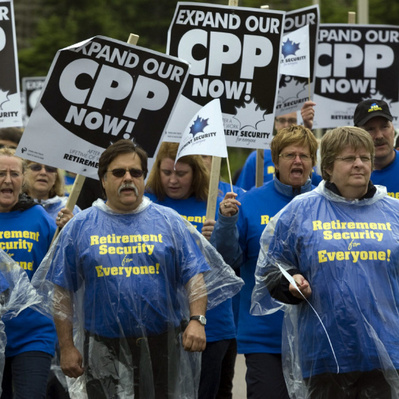
Amidst the plethora of media reports on “payroll tax” increases for 2012, there was little mention of increases in benefits.

There are, of course, two sides to social insurance programs.

Starting in January, CPP benefits – indexed to inflation – rise by 2.8% to a new monthly maximum of $986.67. (You can’t say that about far too many defined benefit pension plans, and there is no inflation indexing of other pensions.)

Reflecting the rise in maximum insurable earnings, the maximum weekly EI benefit goes from $468 to $485 per month.

The amount of earnings replaced by both EI and CPP will increase, giving rise to a premium increase in non inflation adjusted dollar terms. But, by the same token, there will be no fall in the real amount of income replaced by EI and CPP benefits during a spell of unemployment or when retiring.

Meanwhile, CPP premiums are unchanged as a percentage of earnings, and the employee EI premium contribution rate is up by an eye watering 5 cents per week per $100 of earnings.

I wonder why the mainstream media highlighted only the cost as opposed to the benefits of these programs?

CWB: farmers should sue for damages

By John W. Warnock
The Leader-Post 
December 31, 2011

Agriculture Minister Gerry Ritz "Law? What law?"
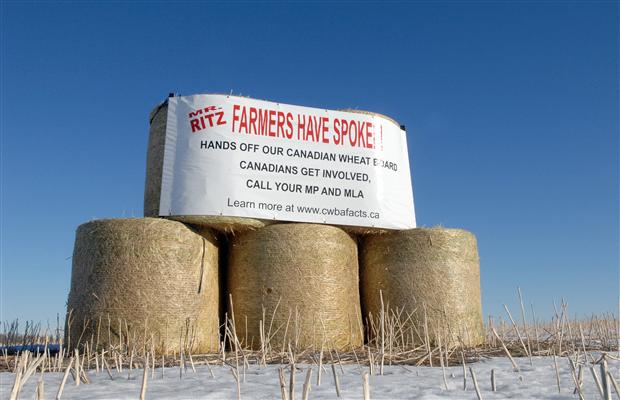
The Harper government has quickly pushed through legislation abolishing the Canadian Wheat Board (CWB) single desk. This was done without a vote from the Prairie farmers who delivered their wheat, durum and barley to the board. A referendum was required in the previous legislation.

During the recent debate over this action, many asked if it would be possible for a future Canadian government to re-establish the CWB single desk. Could it pass legislation that would allow grain farmers to decide the issue? The consensus response seems to have been "yes," but under Chapter 11 of the North American Free Trade Agreement (NAFTA) the government would likely have to pay compensation to agribusiness corporations for any loss of income. That could be substantial.

Saskatoon Community Clinic celebrates 50 years of medicare

Click image above to enlarge

Friday, December 30, 2011

The glorious heritage of Saskatchewan women (1952)

Honouring Canadian women through thirty years of glorious struggle

BY ANNIE S. BULLER
National Affairs
May 1952
From the Socialist History Project

Excerpt from the full article...

Annie Buller addressing a crowd before the Estevan Riot

Here is a chapter that was written in the blood of our people. Who can ever forget the three murdered miners in Estevan? Who can ever forget the women and children of Bienfait-Estevan during the strike, the parade and the trials? During the parade in Estevan the women were in the front lines, fearless and defiant, fighting for the lives of the men. They saw the miners shot, they saw their blood, and they were determined that the battle was not to be in vain. The miners and their wives could not be bought. They did not turn Judas and did not give evidence against the strike-leaders during the trials. It was not because they were not approached and that every effort was not made to corrupt and demoralize them.

A Multimedia Introduction to the Communist Manifesto

Committees of Correspondence for Democracy and Socialism

Saskatchewan's Farm Movement (1901–49)

By Stuart A. Thiesson
Encyclopedia of Saskatchewan

 Ox cart of wheat and straw, Saskatchewan, 1905
Agricultural settlement was well advanced before the formal creation of the province of Saskatchewan in 1905. Wheat was king: this reality had not escaped the attention of the open- market trade members of the Winnipeg Grain Exchange, who, in collaboration with the Canadian Pacific Railway (CPR), were unchallenged in actively exploiting export grain buying opportunities. Farmer grievances began to build over complaints of unfair grading practices, excessive dockage, short weights, and unreasonable and monopolistic pricing and shipping practices.

Farmer anger had been building when W.R. Motherwell and Peter Dayman called a general meeting in Indian Head for December 18, 1901. It was unanimously resolved that united action was needed; and after drafting a constitution and by-laws, the Territorial Grain Growers Association (TGGA) was organized. Following a rapid expansion in membership, the first convention of the TGGA was held on February 12, 1902, where Motherwell was elected president and John Miller secretary. The fledgling organization soon had its first court challenge against the CPR agent in Sintaluta, who had refused to honour a “Car Order Book” provision under the Manitoba Grain Act, whereby a farmer might independently obtain a grain car, and load and ship his grain to market. The organization won the case, which was then appealed to the Supreme Court by the CPR; the Supreme Court upheld the lower court’s decision, establishing for all time the farmers’ right to the use of the Car Order Book. The Sintaluta trial represented the first major victory for the organized movement.

Does it matter if our laws are passed illegally?

By Peter H. Russell

Globe and Mail
Dec. 30, 2011

On Dec. 15, the Governor-General gave royal assent to Bill C-18. This means that the Marketing Freedom for Grain Farmers Act, the legislation that ends the Wheat Board’s monopoly of wheat and barley sales, is now the law of Canada – or is it?

The question arises because on Dec. 7, Federal Court judge Douglas Campbell ruled that the way Bill C-18 was introduced into Parliament violated the Canadian Wheat Board Act. Section 47 of the act requires that the Minister of Agriculture not introduce in Parliament a bill that would end the Wheat Board’s control of all wheat or barley sales without first consulting the board and holding a vote to determine whether farmers favour such a change.

Death of the Dear Leader

New Left Project
December 30, 2011

John Feffer is the co-director of Foreign Policy in Focus at the Institute for Policy Studies. He spoke to Alex Doherty about the politics of North Korea under the late Kim Jong Il and where the country may go from here.

Outside of North Korea and China Kim Jong Il is largely viewed as at best a laughable buffoon and at worst as a monstrous dictator who presided over one of the most repressive regimes in modern history. How do you think history will judge Kim Jong Il and his regime?

I think that Kim Jong Il will be judged harshly, as harshly as Enver Hoxha in Albania. Both leaders managed to preserve the independence and sovereignty of their countries – but at enormous costs. They both steered paths between the superpowers. They both aspired to create autarkic economies and monolithic cultures. Their policies, however, resulted in surveillance states, poverty, and isolation. Additionally, Kim Jong Il had none of the charisma of his father and all of his ruthlessness. He ushered his country into the nuclear club, which may well have staved off military intervention from outside. But the proliferation policies of the regime – regarding Pakistan, Iran, probably Syria – have not made the world any safer.    

Thursday, December 29, 2011

Just because you're an atheist doesn't make you rational

Once you make it your primary aim to refute the existence of God, you miss what's really fundamental

By Mark Steel
The Independent
29 December 2011

Having followed the latest debate about religion, I'd say the conclusion is obvious that the only thing as disturbing as the religious is the modern atheist. I'd noticed this before, after I was slightly critical of Richard Dawkins and received piles of fuming replies, that made me think that what his followers would like is to scientifically create an eternity in laboratory conditions so that they could burn me there for all of it.

It's not the rationality that's alarming, it's the smugness. Instead of trying to understand religion, if the modern atheist met a peasant in a village in Namibia, he'd shriek: "Of course, GOD didn't create light, it's a mixture of waves and particles you idiot, it's OBVIOUS."

The connection between the religious and the modern atheist was illustrated after the death of Christopher Hitchens, when it was reported that "tributes were led by Tony Blair". I know you can't dictate who leads your tributes, and it's probable that when Blair's press office suggested that he made one to someone who'd passed on, he said: "Oh, which dictator I used to go on holiday with has died NOW?"

The second cold war and South America

By Raúl Zibechi
Latin America in Movement
December 24, 2011

The "war against terror" inaugurated by George W. Bush as a response to the September 11 2001 attack is now giving way to a strategy of "containment" of China, the new strategy laid out by the Pentagon to encircle, and eventually stifle the asiatic power, with the objective of maintaining US global supremacy. The new course of the Empire includes South America.

The change of course appeared in November. "In our plans and proposals for the future, we shall dedicate resources to maintain our strong military presence in the region", said Barack Obama on November 17 to the Australian parliament. In the November edition of Foreign Policy, secretary of State Hillary Clinton filled in some of the gaps. "During the past ten years we have dedicated considerable resources to Irak and Afghanistan. During the next ten years, we have to look carefully at an intelligent use of our time and energy, in a way that we establish the best possible position to maintain our leadership."

The Year in Revolt

After rage, riots and revolution, the top to-do for 2012 is closing the divide. 

By Bob Mackin
December 29, 2011

The year 2011 has been brought to you by the letter R.
As in revolt, rage and riot.

Globally, nationally, regionally and locally, the biggest stories of the year had some element or degree of revolt in the foreground or background.

Millions of people supported or joined movements to express vigorous dissent as they grappled with an unstable present and uncertain future. If they weren't marching on the street, they were expressing frustration via social media. Their rage was not centralized, nor was it all peaceful. There were riots and even deaths.
First on the scene were citizens with smartphones and tablets, employing social media networks to witness the rage and spread the message. The commercial media often played catch-up.

Wednesday, December 28, 2011

Girl re-booted

Does the world need a second The Girl with the Dragon Tattoo film? Yes, says John Rees.

By John Rees
CounterFire
28 December 2011
Also see How Stieg Larsson trained Marxist guerrillas in Eritrea

You might think the world is already saturated with Stieg Larsson’s The Girl with the Dragon Tattoo. Sales of the original novel stand at over 30 million copies. It’s the first novel to sell over a million Kindle copies alone. When the first Swedish screen adaption, released in cinemas less than 2 years ago, came out as a DVD it became the fastest selling disc in UK history.

And there is another reason for scepticism: the plot of The Girl with the Dragon Tattoo is not exactly new. For those who have been on a long-term mining expedition on one of Saturn’s less accessible moons it involves the disappearance of Harriet Vanger, a young member of an industrialist’s family, on an island in northern Sweden in the summer of 1966. There is only one way off the island over a road bridge and that was blocked by an accident when Harriet disappeared. Was Harriet killed? And if so which member of the Vanger family is responsible? In short this is a country house mystery of the kind made famous by, variously, Conan Doyle, Agatha Christie and Cluedo. Larsson himself makes the point in the book ‘It's actually a fascinating case. What I believe is known as locked room mystery’.

Bound for Local Glory at Last

By
New York Times
December 27, 2011
Also see Woody Guthrie: Redder Than Remembered
 
TULSA, Okla. — Oklahoma has always had a troubled relationship with her native son Woody Guthrie. The communist sympathies of America’s balladeer infuriated local detractors. In 1999 a wealthy donor’s objections forced the Cowboy Museum in Oklahoma City to cancel a planned exhibition on Guthrie organized by the Smithsonian Institution. It wasn’t until 2006, nearly four decades after his death, that the Oklahoma Hall of Fame got around to adding him to its ranks.

But as places from California to the New York island get ready to celebrate the centennial of Guthrie’s birth, in 2012, Oklahoma is finally ready to welcome him home. The George Kaiser Family Foundation in Tulsa plans to announce this week that it is buying the Guthrie archives from his children and building an exhibition and study center to honor his legacy.