Wednesday, November 2, 2011

Green Party Policy: Workers' Rights

Green Party of Saskatchewan
Worker's Rights Resolutions 1998-2007:

1998.5. Just transition policy

Be it resolved that the Green Party of Saskatchewan support the concept of just transition for all workers currently working in unsound industries and publicly discuss the concept of just transition as a way of taking workers into the new sustainable economy.

1998.6. Labour legislation

Be it resolved that the Green Party of Saskatchewan work with our labour allies to implement legislation pertaining to anti-scab provisions, pay equity and most available hours.

Retirees, SGEU battle over pension

By Terrence Mceachern
Leader-Post
November 2, 2011
Photographs by: Bryan Schlosser

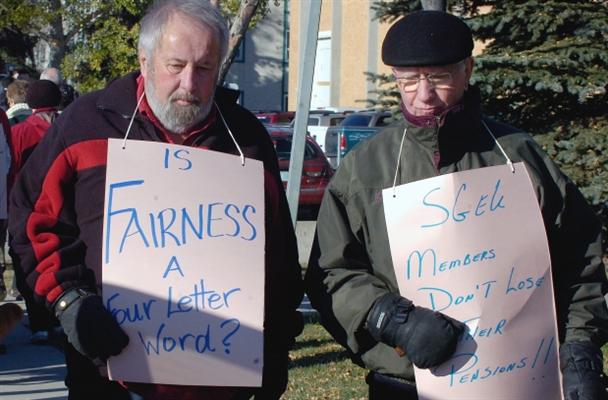
Betty Pickering, retired SGEU staff (right)
Betty Pickering said she was shocked on Friday when she found out her pension payments were going to be reduced by twice the amount that was originally agreed to by her former employer in February.

“The reduction we took was hard enough to swallow. And then to say you’re going to have to take a double reduction is absolutely impossible,” said Pickering, 63, who retired from the Saskatchewan Government and General Employees’ Union (SGEU) in 2004 after a 20-year career.

“We shouldn’t be asking people who live on a fixed income to do this. Everything else for our cost of living is increasing. Now we’re asked to take a reduction — that’s disgraceful, absolutely disgraceful,” she said.

After 40 former employees filed a class-action lawsuit against the union earlier this year, a deal was reached in mediation on Feb. 26, said Pickering. But after hearing the news of further pension reductions on Friday, Pickering and 20 supporters and former colleagues protested in front of SGEU’s Regina office Wednesday morning calling for new provincial legislation protecting pensions.

“Clearly SGEU needs to stick to the deal that was made. We will take the reduction we agreed to in mediation, not a penny more,” said Pickering.

She said she wasn’t able to divulge the amount SGEU was planning to reduce their pension because the matter was agreed to in mediation. She said during the group’s discussions with SGEU, the union blamed the market for the need to further reduce their pensions.

Bob Bymoen, president of SGEU, agreed the markets led to changes to the pension but denied SGEU reneged on the deal. Bymoen said the situation is unfortunate, but explained that disagreements between the former staff and SGEU over shared contributions led to the pension plan being “wound down.” The plan would be used to purchase annuities, or financial products that pay the individual a fixed amount of money over time. Even though the annuities are only scheduled to be purchased in the next couple of months, the value of the pension is forecasted to be lower because the market is declining, he said.

“That’s going to have a net result of a lower pension, it’s not that anybody’s waffling on an agreement, it’s just what is happening around us is putting stress on the plan,” said Bymoen. He estimated the pension plan’s value could be reduced as much as 15 per cent, based on current figures.

Later in the day, the protest moved to downtown Regina in front of Dave Wild’s office. Wild, the superintendent for pensions for the Government of Saskatchewan, said he has sympathy for the retirees, but that this is a matter between them and the SGEU.

“They were expecting to enjoy greater pensions than they are going to receive, but it is essentially a private contractual matter,” he said.

Pickering, who serves as president of the Saskatchewan Federation of Union Retirees, said the matter is being evaluated and that further legal action could follow, but she added that paying legal fees is a serious concern given that the retirees are on a fixed income.


Former SGEU employees protest pension cut

CTV News
November 2, 2011

Retired former employees of the Saskatchewan Government and General Employees' Union protest a pension cut in Regina on Wednesday.

Dozens of retired former employees of the SGEU held a protest in Regina on Wednesday after the union said they would have to take a big cut to their pensions.

The Saskatchewan Government and General Employees Union and former workers met with a mediator in February and had agreed to an initial pension decrease. But retirees now say they've been told that amount will be doubled.

The change in pension benefits is a big blow for former workers living on a fixed income. They say they're' considering further legal action, and calling for legislation that would see pensions protected in Saskatchewan.

The SGEU says lower annuity rates are to blame, and that the union has already subsidized the pension plan. However, premium rates are still much lower than it had anticipated.

Interview with Chilean student leader Camila Vallejo: They'll see that it's worthwhile

camilavallejo298x437Reporters call her the Chilean La Pasionaria, the name given to Spanish Civil war hero Dolores Ibarruri. For the UK Guardian, she's "Commander Camila" and a "Latin American folk hero." She's president of the Chilean Students' Federation, and a picture of Karl Marx hangs in her office.
 
Camila Vallejo, 23 years old, has been instrumental in propelling Chile's student movement, mobilized now for almost six months. Student demands have ranged from free, quality education to basic constitutional change. Vallejo, a member of the Chilean Communist Youth organization, was interviewed recently by Voz ("Voice, the Truth of the People"), the Colombian Communist Party's weekly newspaper. 
-- W.T. Whitney Jr.

In the midst of turbulent struggle unleashed in the streets of Chile, Camila Vallejo runs from meeting to meeting, keeping up with her obligations as a militant of the Chilean Communist Youth, student head, and people's leader. Right in the streets of Santiago, Chile, Voz spoke exclusively with Camila Vallejo who from the perspective of the movement discussed with us the student struggle in Chile. And she confessed to following the Colombian students' struggle and encouraged the students there not to weaken.

What does the student movement represent for Chile today?

Lisa Raitt’s Three Principles of Labour Law

By Jim Stanford 
Progressive Economics Forum
November 2nd, 2011

Posted below is a slightly longer version of my column in today’s Globe and Mail regarding the Harper government’s highly creative approach to making up labour law on the run.

Also posted is a graph showing the dramatic decline (of 95% or more) in the frequency of work stoppages in Canada since the mid-1970s. In 2010 only 0.03% of work time was lost to work stoppages (including lockouts like U.S. Steel), just a smidge higher than the all-time postwar record low of 0.02% reached in 2008 (source: calculated from StatsCan variables 4391647, 15856467, and 4391505, assumes 8-hour working day and 250 working days per year) .


Here’s the Globe and Mail Column:

The rule of law has suddenly been given a rather flexible interpretation by the Harper government in Ottawa, in the arena of labour relations. In just six months in power, the Conservative majority (fronted in this realm by Labour Minister Lisa Raitt) has intervened three times to end or prevent work stoppages.

Saskatchewan Agriculture: Is it time to take a different approach?

Green Party of Saskatchewan
November 2, 2011

With farms getting bigger and bigger, taking more and more people out of the rural areas and into the cities, it is time to really do something to encourage people to remain or to return to the small towns and to the rural areas.

The industrial agriculture approach is killing the social fabric of Saskachewan. The major cities are growing at unprecedented rates but the small towns, not affected by oil or potash, are dying.

Industrial agriculture involves far too many toxic chemicals to the tune of over 100,000,000 litres every year in our province according to 2006 figures, Statistics Canada. Compound this with hundreds of thousands of tonnes of fertilizers, these practices are contaminating the ground water, lakes, rivers and the air we breathe. Pesticide residues are found in our grains even to the scale of rejection of certain products by overseas customers. Chemicals and disease are killing too many beneficial insects, including bees, which could cost us billions of dollars in the next few years.

A Green Party government would:
  • Assist farmers financially to move through the three-year transition period necessary to change from conventional to organic farming
  • Set up a provincial system to help organize small producers to market their goods, also expandng the existing farmers markets. We will make sure the labeling of food includes the presence of GMO (genetically modified organisms) where applicable
  • discourage large industrial agriculture, encourage small farms to be viable which would ensure that more money stays in the province and not to large corporate companies
  • work with farmers/producers to grow and process more of our own fruit and vegetables like cabbage, root crops, apples, etc all proven to be possible in Saskatchewan
  • A Green Party government would ensure that policies and practicies in the agricultre sector would reverse the rural depopulation trends that have been taking place for the past 50 years.
What are we leaving our children? What we are experiencing is not all healthy growth, but corporate growth. Let us continue to be a "have province" by examining exactly what we have and determining whether or not it is sustainable or is it just short term opportunity.

The average Canadian farmer is 58 years old. Who will grow our food in the future? Hopefully our children will, not some corporate farm from another country

Tunisia Elections: The Real Thing This Time

By Rob Prince
Foreign Policy in Focus
November 2, 2011

It was only 2005 — not all that long ago — that Zine Ben Ali won his third term as Tunisia’s president with 99 percent of the vote. At the time, critics dismissed the results as farcical, yet another attempt to put perfume on a police state known virtually universally for smothering any independent voice or democratic sentiment.

Tunisian dissidents viewed the 2005 results as a step in Ben Ali’s campaign to make himself president for life — or worse, through a change in the constitution, to open the door for his wife Leila Trabelsi and her clan to seize power. Concerns of this nature, and widespread anger at the clan’s unbridled greed and treachery, were a vital part of the mix that ignited the Tunisian revolt which began last December.

Obsessed with a largely non-existent radical fundamentalist threat in the country, the Bush administration defended Ben Ali as an ally of the United States in its “war on terrorism.” But so pervasive was the knowledge of Ben Ali’s abuses that even the Bush administration was uneasy and embarrassed by the charade — which is saying something.

The case of Iceland – the illusion of an amicable default

By Luca Lombardi 
In Defence of Marxism
02 November 2011

As Europe teeters once more, staring financial collapse and slump in the face, we provide an analysis of what happened in Iceland, the first country to go under as a result of the global crisis of capitalism.

Protests in Reykjavik in January 2009Protests in Reykjavik in January 2009. Photo: finnur malmquistIn 2008, Iceland suffered the biggest financial collapse any nation has ever had, if we consider the size of its economy. Even more striking is the fact that Iceland is no emerging country, mesmerized by the sirens of Western finance, but a modern, affluent nation with a Scandinavian welfare state.

Before the crisis erupted, Iceland, a remote Atlantic island, with the inhabitants of a medium sized European city, was a country famous for its natural wonders visited by many people from all over the world as well as for its music. The collapse of the country’s three major banks (Kaupthing, Landsbanki and Glitnir) led to financial disaster and street protests that toppled the government.

Read more HERE.

Premier Wall can't have it both ways

By Jim Harding
No Nukes
We could finish this election campaign without serious issues even being raised, which isn’t the way to practice democracy. One such issue is whether thousands of truckloads of highly radioactive nuclear wastes will be brought from Ontario’s nuclear plants to a nuclear dump in our north.

Premier Wall sidesteps the issue; there was no concern expressed when Pinehouse,  Patuanak and Creighton were targeted as potential sites for a nuclear dump. On April 14th North Battleford groups delivered 5,000 signatures of people opposed to such a dump. Afterwards the Premier publicly acknowledged the “negative public opinion about a nuclear waste facility”, adding “I don’t think the mood of the province has changed, and frankly, what’s happening in Japan has got people thinking…” This left an impression that his government didn’t support a nuclear dump, but the industry-run Nuclear Waste Management Organization (NWMO) carried on with its monetary inducements in the north.

Tuesday, November 1, 2011

Gathering for Housing in Regina

Click image above to enlarge

History Repeats Itself with Somalia Invasion

By Francis Njubi Nesbitt
October 31, 2011

Kenya’s ill-advised incursion into Somalia on Oct. 16 after a rash of kidnappings in the tourist paradise of Lamu will most likely lead to a long and expensive quagmire. The escalation will further destabilize a region already reeling from war, piracy, famine, and international terrorism.

Kenya insist that it not at war with Somalia but only defending its borders and pursuing non-state actors, such as the al-Qaeda-linked al-Shabaab, who stand accused of abducting and killing innocent civilians. 

Unrest in Bill’s Republic of Doyle

PotashCorp CEO Bill Doyle
PotashCorp CEO Bill Doyle waded into Saskatchewan’s election campaign on Friday with an op-ed in the province’s two largest newspapers. It was accompanied by a paid advertisement from PotashCorp in Saskatoon’s StarPhoenix.

The company got some free advertising in Regina’s Leader-Post through Bruce Johnstone’s column, which repeated Doyle’s op-ed. The Saskatchewan Party is parroting the same lines.

In response to Doyle, former Member of Parliament and PotashCorp director John Burton has an excellent op-ed in today’s Leader-Post. I have the following op-ed in today’s StarPhoenix:

Green Party Candidate Ingrid Alesich Blasts Sask Party, NDP on Childcare

PRESS RELEASE: GREEN PARTY CHILDCARE POLICY PAYS FOR ITSELF

Canada is last out of all the OECD (Organization for Economic and Co-operation and Development) countries in providing good quality, accessible childcare services and Saskatchewan is last in numbers, quality and affordability in the country.

Neither the NDP, nor the Sask Party are committed to changing the situation in any real way. The NDP had an opportunity to bring in low cost, accessible, childcare in their last governments. Several dozen studies and royal commissions in Canada over the last 40 years have all recommended: “Free, universally accessible, publically funded daycare” as the basis for critical early learning years for our future generations, for providing parents opportunities to gain higher education and attend work.

NDP Needs to Back Canada’s 99%

Party Has Potential to Guide Muddled Movement

Brian Lapuz
The Link
October 24, 2011

Canadians are standing together against the current economic divide in our population via Occupy movements ongoing in almost every major city in this country. Like their peers around the globe, this country’s poorest “99 per cent” are out on the streets and asking for change.

While their qualms with the capitalist system have been made clear, the movement has been met with criticism for lacking direct and specific demands for change.

Fortunately for the 99 per cent in this country, we have a political party that has long supported the rights of the working class; a party with socialist roots. This is the time for the New Democratic Party to seize the opportunity to defend and guide the interests of the Canadian 99 per cent.

Tar Sands: A Saskatchewan perspective

By Karen Rooney
Youth for Climate Action
October 14, 2011

When people hear the term “tar sands”, the province of Saskatchewan is not usually what comes to mind. And while as a province we have been able to slip under the radar, both the impacts of Alberta’s tar sands on our province and our own potential tar sands development are very tangible.

Each year, more than 150,000 tonnes of acid-producing emissions are generated by the Alberta tar sands. It can take anywhere from 2-14 days before these toxic emissions are re-introduced into land or water, in the form of acid-rain. Because of this time lapse between the production of emissions and the deposit of acid rain, land and water up to 1,000 kilometres away from the original source can be drastically affected by tar sands emissions.

What does this mean for Saskatchewan?